
Almost every piece of dog gear is sold by weight. “For dogs 50–90 lbs.” It is the one number that tells you least about whether something will fit.
A 75 lb Labrador and a 75 lb Doberman are not the same shape. One is broad and barrel-chested; the other is deep and narrow. A collar that suits one rides badly on the other, and a harness sized by weight will be wrong for at least one of them. On large breeds the mismatch gets worse, because the spread of body shapes at any given weight is wider.
Five measurements cover essentially everything you will ever buy. They take about five minutes with a soft tape measure, and once you have written them down you can size any product without guessing.
What you need
A soft fabric tape measure — the kind used for sewing. If you do not have one, use a piece of string and hold it against a ruler afterwards. A rigid builder’s tape will not follow the curve of a chest or neck and will read short.
Measure your dog standing normally on a flat floor, not sitting, lying down or mid-stretch. If they will not hold still, do it after a walk rather than before.
1. Neck girth — for collars
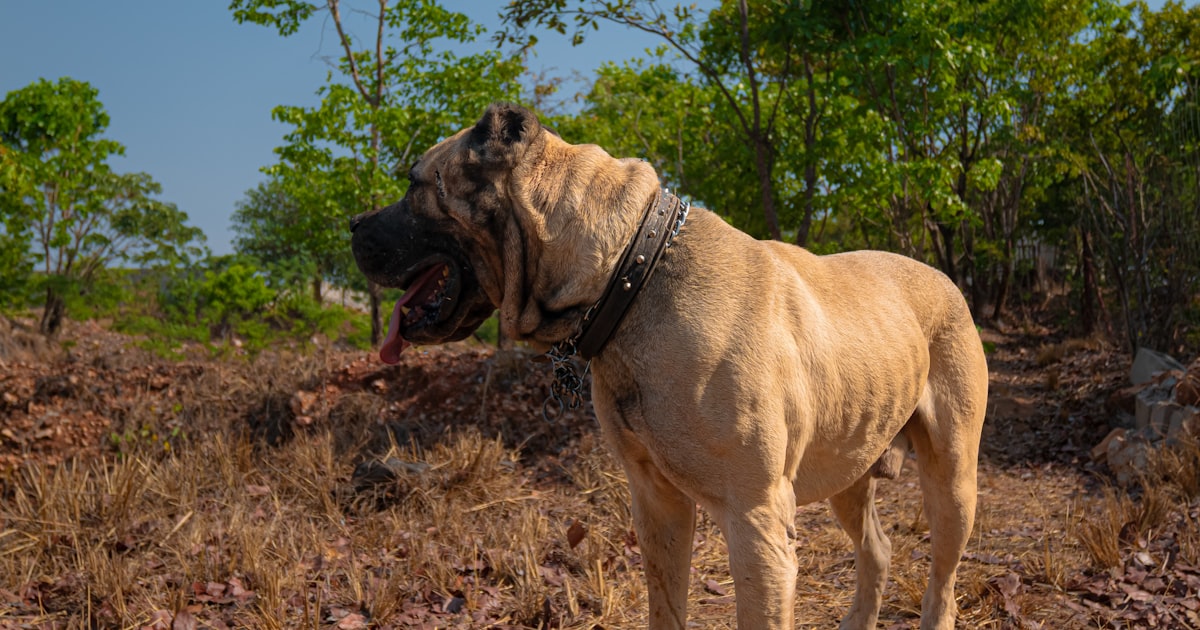
Run the tape around the base of the neck, where a collar naturally sits — low, close to the shoulders, not high up under the jaw. Keep it snug against the coat without compressing it.
The two-finger rule: once you have the number, you should be able to slide two fingers flat between the tape and your dog’s neck. If you cannot, the collar will be too tight. If your whole hand fits, it is loose enough to slip over the head — which is how large dogs get loose at exactly the wrong moment.
Double-coated breeds are a trap here. Measure through the coat, not under it, and re-check after a heavy shed or a summer clip, because the number genuinely changes. Our large dog collar guide covers width and hardware, which matter as much as circumference once you are past 50 lbs.
2. Chest girth — for harnesses, vests and life jackets
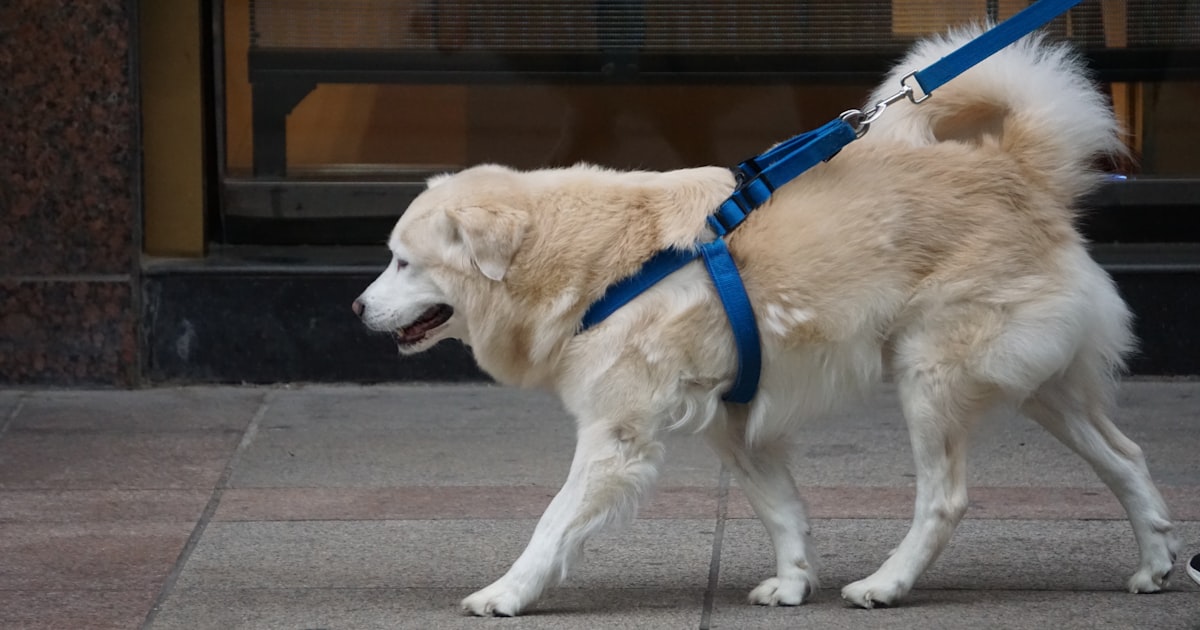
This is the single most useful measurement you will take, and the one most people skip.
Measure around the widest part of the ribcage, just behind the front legs. Keep the tape level and snug. That circumference — not weight — is what determines whether a harness, an anxiety wrap or a life jacket fits.
It matters most for deep-chested breeds. A Doberman, Great Dane or Weimaraner carries a lot of depth relative to their weight, so weight-based sizing routinely puts them in something too small. Every serious manufacturer publishes a girth range; use it in preference to the weight range printed on the front.
- No-pull harnesses — girth plus, for front-clip designs, where the chest strap sits
- Life jackets — girth decides the fit; a jacket that rides up is worse than none
- Anxiety vests — these work by even pressure, so girth accuracy is the whole mechanism

Flotation is the case where getting it wrong carries a real cost. A life jacket sized by weight on a deep-chested dog sits too far forward, rides up over the shoulders in the water, and pushes the head down rather than holding it up. Girth first, then check the handle sits over the centre of the back rather than the neck.
3. Length, nose to tail base — for crates and beds
Measure from the tip of the nose to the base of the tail, where the tail joins the body. Not to the tip of the tail — including it will push you a whole crate size up.
Add 2–4 inches. That gives the minimum interior length for a crate, and a sensible minimum for a bed your dog can lie on fully stretched rather than curled.
Beds are worth a second thought. Dogs that sprawl on their side need more length than the measurement suggests, and a dog whose legs hang off the edge every night will develop pressure points on their elbows. Our orthopedic bed guide covers foam depth, which matters more than surface area once a dog is heavy. For crates specifically, crate sizing by breed walks through the 42 / 48 / 54 inch decision.
The same length number sizes a grooming table. A table shorter than your dog leaves the back feet hanging off the end, which is where most of the fidgeting starts — and a dog that will not stand still is the real reason home grooming gets abandoned. Our grooming table guide compares the usable top sizes, which matter more than the height adjustment range on a large dog.
4. Height — and why you need two of them
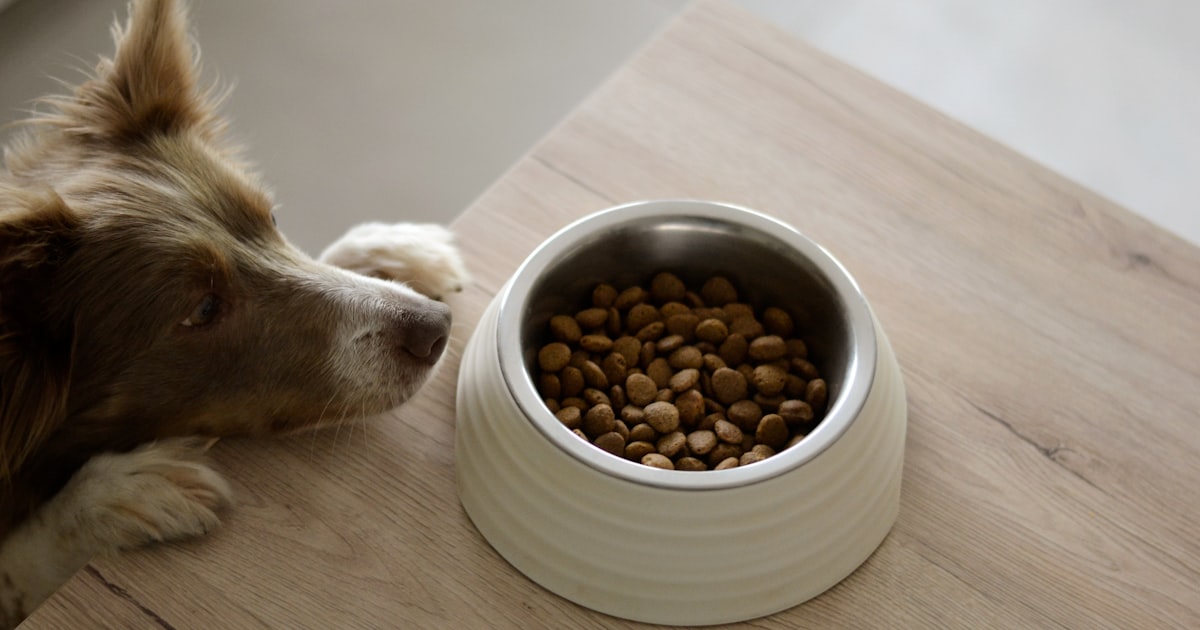
Two different heights matter for two different things, and they are not interchangeable.
Sitting height — floor to the top of the head while your dog is sitting. For most large breeds this is taller than standing height, and it is the number that decides whether they can sit up in a crate without ducking. Add 2–4 inches.
Shoulder height — floor to the top of the shoulder blade, the withers. This is the standard breed measurement, and it is what sets the right height for a raised feeder. Our elevated bowl guide covers how to work back from it, and what the research on bloat actually supports.
Both heights matter again for containment. A panel only has to be shorter than your dog’s reach for a paw to get over the top, and a determined large breed will find that out faster than you will. Our playpen guide covers why panel height, not floor area, is the specification that decides whether a pen actually holds.
5. Paw width — for boots
Boots are the most commonly mis-sized item on this list, because almost everyone measures the paw wrong.
Place your dog’s paw on a sheet of paper and press their weight down onto it — lift the opposite leg if you need to. A paw at rest is noticeably narrower than a paw bearing weight, and a boot sized to the resting measurement will pinch or twist the moment your dog walks in it. Mark either side of the widest point and measure between the marks.
Measure the front paws. On most large breeds they are wider than the rear, and boots are sized to the larger pair. Our dog boot guide covers closures and which designs actually stay on, which is the other half of the problem.
Quick reference
| Gear | The measurement that decides fit |
|---|---|
| Collar | Neck girth, plus two fingers |
| Harness | Chest girth behind the front legs |
| Life jacket | Chest girth |
| Anxiety vest | Chest girth |
| Crate | Nose-to-tail-base length + sitting height |
| Bed | Nose-to-tail-base length, plus room to sprawl |
| Elevated bowl | Shoulder height |
| Boots | Front paw width, measured under weight |
| Ramp | Height of the surface you are loading into |
The one measurement that is not on your dog
Ramps are sized to the vehicle, not the animal. Measure from the ground to the load lip of your boot, tailgate or back seat, then check that against the ramp’s length — a longer ramp over the same height gives a shallower, more usable incline.
As a rough guide, a ramp roughly three times the height of the step gives an angle most dogs will use willingly. Too steep and an arthritic dog will refuse it, which defeats the point of owning one. Our dog ramp guide covers capacity and grip surface.
When the numbers change
Measurements are not a one-off. Three things move them, and all three catch people out.
Growth. Large breeds keep filling out well past the point they look adult — most are not structurally finished until 18 to 24 months, and giant breeds later still. A harness bought at ten months is often wrong by fourteen. This is also why crates are bought at adult size with a divider rather than replaced twice.
Weight. A few kilos either way shows up in chest girth before it shows anywhere else. If your dog has gained or lost noticeably, re-measure before assuming last year’s size still applies.
Coat. Double-coated breeds change neck and girth measurably between a full winter coat and a post-shed summer one. Measure through the coat as it is now, and expect collar fit to need adjusting seasonally rather than staying put.
For an older dog there is a fourth: muscle loss along the back and hindquarters changes how a harness sits, often without much change in weight. If a harness that fitted for years has started rubbing, that is usually why — what changes as a large dog ages covers the rest of it.
Mistakes worth avoiding
- Trusting the weight range. It is a marketing shorthand. Girth and length are the real constraints.
- Measuring a sitting dog. Everything except sitting height should be taken standing.
- Including the tail. Length runs to the base of the tail, not the tip.
- Measuring paws at rest. Weight spreads the paw; a resting measurement gives boots that pinch.
- Measuring once. Puppies outgrow gear fast, and an adult dog’s neck and girth shift with weight and coat.
Write them down
Keep the five numbers in your phone: neck girth, chest girth, length, sitting height, front paw width. Re-take them roughly twice a year for an adult dog, and every few weeks for a growing one.
Almost every sizing mistake on this site’s guides — and there are plenty in the wider market — comes down to somebody buying from a weight label instead of a tape measure. Five minutes now saves a return later.
If you want to see how badly that goes wrong in practice, we
audited our own
76 product links and found 15 of them opened the wrong size — including
an XX-Small harness on a guide for large dogs.